An executive's guide to reducing delivery risk in water infrastructure
Introduction: What this guide covers
This guide is for water leaders overseeing major infrastructure programmes under AMP commitments. It outlines why delivery risk increasingly becomes executive exposure, where traditional oversight falls short, and how portfolio-level visibility can strengthen confidence, governance, and regulatory performance.
The visibility gap in capital delivery
Water infrastructure delivery in the UK is entering a defining period.
C-suite leaders are directly accountable for programme performance against:
- Ofwat commitments and evolving regulatory expectations
- Environment Agency scrutiny
- Government expectations
- Customer and public confidence
Performance is measured through Environmental Performance Assessment ratings, Outcome Delivery Incentives, AMP commitments, and the avoidance of fines and reputational damage.
At the same time, capital programmes are increasing in scale, interdependency, and environmental sensitivity. Multiple projects progress simultaneously across shared assets, constrained urban environments, and interconnected catchments.
Governance structures provide visibility into cost, schedule, and compliance. However, delivery risk often forms in the physical overlap of projects, constraints, and environmental conditions long before it appears in formal reporting.
The challenge is not a lack of data. It is a lack of shared, portfolio-level delivery context.
Why delivery risk surfaces too late
In most AMP programmes, risk does not appear suddenly. It accumulates quietly in site constraints, design assumptions, contractor sequencing, and overlapping works.
By the time it surfaces formally, flexibility has already narrowed.
Budgets may move, but deadlines do not.
When issues emerge after options are fixed or contractors are mobilised, rework increases and delays compound. What begins as a delivery issue quickly becomes executive exposure.
Across UK infrastructure programmes, standard construction delays commonly increase project costs by 11 to 20 percent or more, with over half of projects experiencing delay. In a fixed AMP cycle, those delays compress programme capacity and reduce strategic headroom.
Three structural issues drive this pattern:
- Fragmented site information
Critical delivery information sits across GIS, CAD, mapping platforms, surveys, business intelligence systems, contractor documentation, email chains, and reporting tools.
No single view exposes the full physical reality of a site.
When constraints or assumptions are discovered late, redesign and remobilisation follow, introducing avoidable cost and time pressure.
- Parallel projects and shared constraints
Dozens or hundreds of projects may progress in parallel within the same catchments, treatment works, or urban corridors.
Upgrades upstream can influence downstream performance. Works can overlap spatially. Constraints compound across programmes.
Without portfolio-level visibility, these interactions remain hidden until coordination becomes reactive and delays ripple across interconnected projects.
- Reporting without physical context
Environmental performance and ODI targets depend on real-world delivery outcomes.
Yet portfolio reporting typically summarises status rather than exposing how projects interact physically across assets and environments. Leaders see progress updates, not emerging constraint conflicts.
When issues appear formally, corrective options are often limited and costly.
A different model: Shared delivery context
Managing delivery risk in AMP8 requires earlier visibility of how projects interact across the portfolio.
This means leadership and delivery teams working from the same contextual understanding of:
- Site conditions
- Design information
- Environmental constraints
- Overlapping works across assets and catchments
When that shared context exists, risk becomes visible while decisions are still flexible.
Leaders can see not only whether projects are progressing, but whether they are progressing coherently and in alignment with regulatory and long-term system goals.
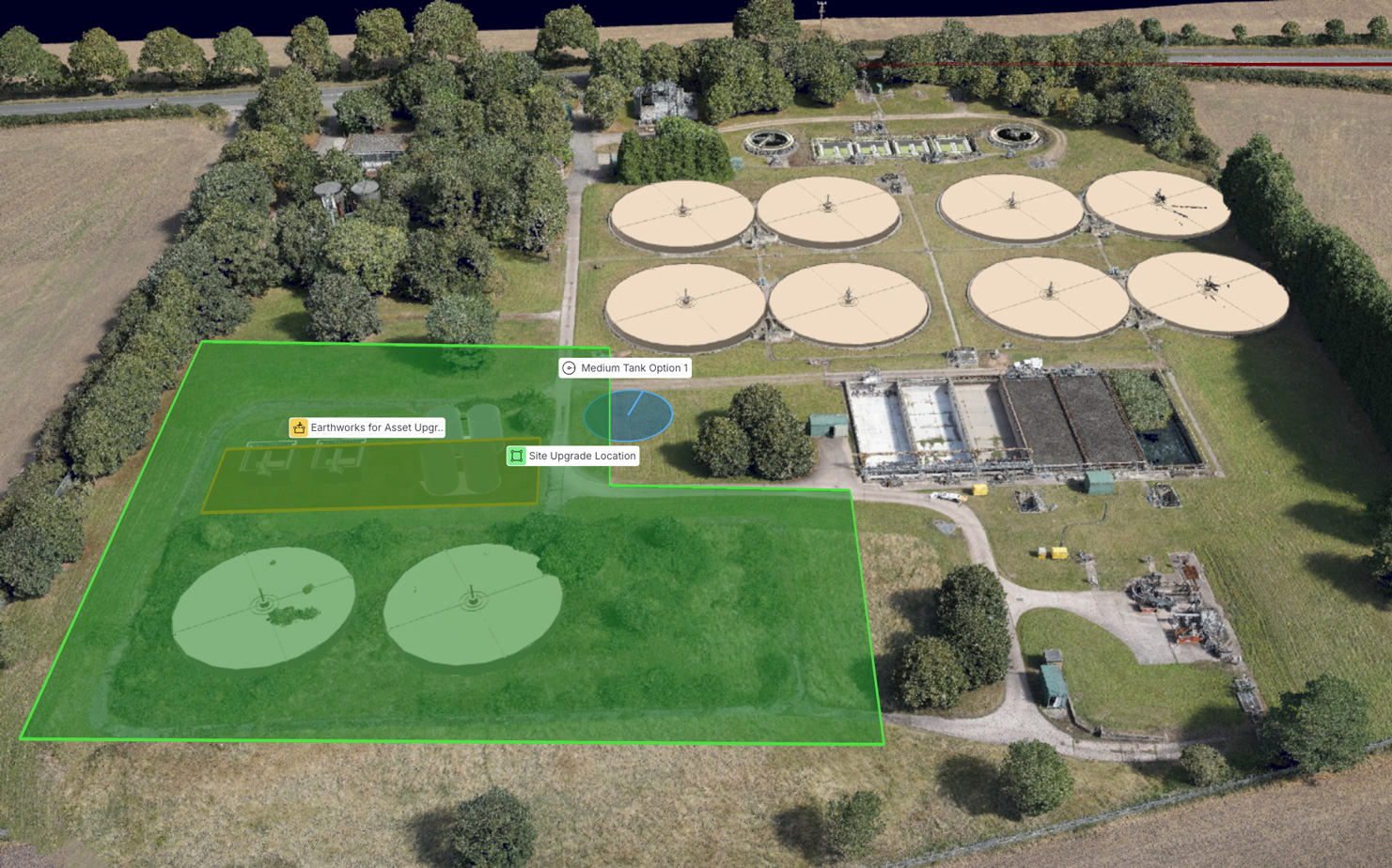
Solutions such as Sensat support this model by connecting site data, surveys, design information, and environmental context into a single shared environment.
The objective is not more reporting. It is earlier clarity for confident, risk-aware decisions.
What changes for UK water leaders
When leaders gain portfolio-level delivery context, several shifts occur:
- Earlier intervention
Emerging risks affecting EPA performance, ODIs, or AMP commitments become visible before escalation, preserving flexibility and reducing the likelihood of delay.
- Greater confidence in AMP delivery
Programme progress is understood in real-world context, not just through milestone reporting. Decision-making improves across multiple simultaneous projects.
- Stronger governance and board-level assurance
Delivery assumptions can be challenged with evidence. Oversight becomes proactive rather than reactive. Boards and regulators receive clearer assurance.
- Reduced reputational and personal exposure
Early awareness of constraints and interaction across programmes reduces the likelihood of late-stage failure and public escalation in a high-scrutiny environment.
Where portfolio visibility matters most
Shared delivery context is most valuable where complexity and scrutiny intersect, including:
- CSO and discharge reduction programmes under environmental oversight
- Large-scale AMP capital upgrades across interconnected assets
- Urban or constraint-heavy environments with limited operational flexibility
- Catchments where upstream and downstream interventions interact
Without portfolio-level insight, leaders rely on status reporting that may obscure emerging constraint conflicts until corrective options are limited.
With shared contextual visibility, executives can anticipate constraints, coordinate overlapping works, and act before flexibility is lost.
Conclusion: From reporting to executive confidence
UK water leaders are not judged on isolated project performance. They are judged on system outcomes across entire programmes.
Executive confidence now depends on how early delivery risk becomes visible, not how well it is explained after escalation.
Reducing delivery risk requires shared contextual awareness across programmes so leadership can act while flexibility still exists.
In the current regulatory climate, portfolio visibility is not an operational convenience. It is executive risk control.
What this means in practice
For water leaders navigating AMP commitments and regulatory scrutiny, the shift from reporting to contextual visibility is operational, not theoretical.
Asset owners making this transition are enabling delivery and leadership teams to work from the same understanding of site context, constraints, and programme interaction.
Sensat enables portfolio-level visibility of delivery context by connecting project activity, site constraints, and programme interaction into a single shared view.
If this perspective reflects the challenges you are navigating, you may wish to:
Explore UK water programmes that are applying shared contextual visibility in practice
Or request a strategic discussion to examine how portfolio-level delivery visibility could support your AMP commitments and regulatory performance.